
Human Spaceflight
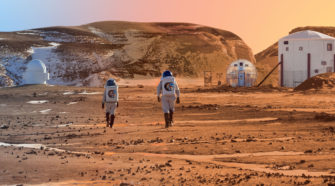
The Mars Society: Humans to Mars in a decade

A long time ago in the Milky Way Galaxy, Chris McKay, Penelope Boston, and Carol Stoker were on Planet Earth contemplating all things Mars. These three scientists, graduate students at the University of Colorado, decided to form a group called the Mars Underground and hold annual meetings to explore the science behind putting humans on …
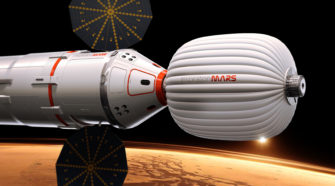
Inspiration Mars plans for human slingshot

Mars seems to be the hottest vacation destination for interplanetary travel right now. With many plans floating around to send rovers, orbiters, even human missions to orbit and settle, Mars is a hot topic in space travel discussions right now. Dennis Tito, the first person to travel to space as a tourist with a purchased …
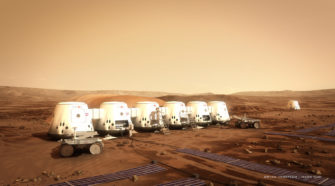
Mars One betting colonizing planet will be great television

Mars One is a non-profit foundation, co-founded by Bas Lansdorp and Arno Wielders, to establish a human presence on Mars. The prime difference Mars One has over similar peer programs is its unique strategy; this is a one way ticket for a permanent “homesteading” community in an apolitical and international long term plan, thus removing …
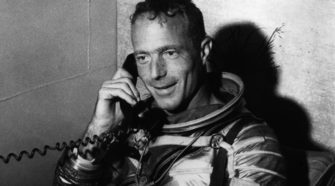
Scott Carpenter: A tribute to a curious but ordinary superman
One of only two remaining Mercury Program Astronauts from the 60’s, Scott Carpenter, sadly passed beyond the veil on Thursday, October 10, 2013 following a stroke in September. He was 88 years of age. Carpenter was one of the earliest pioneers in the infancy of the Space Age. He was the second American to cross …
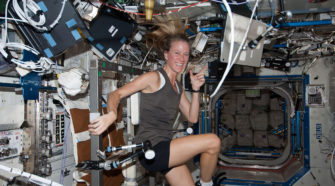
Importance of exercise while in orbit

Human space flight is a physically demanding experience. It poses numerous risks, many of them are very evident, but some are hidden to the naked eye. The most important hidden health challenge is the bone density changes that are brought on by prolonged weightlessness. These bone density changes in the hip and back are very …
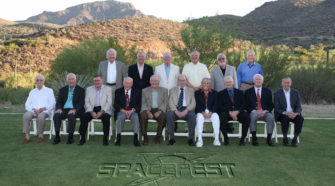
Spacefest V: The ultimate party for space lovers
Recollections of Spacefest V “The past is prologue” as I once heard. A once politicised and technology based race to the Moon has yielded innumerable spin-off benefits and technology, but has also served as a prologue to many other events. The birth and rise of the new commercial space industry. International Space Agency cooperation with …
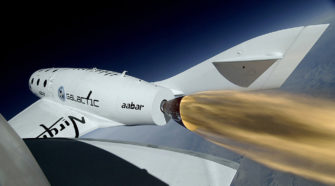
Can SpaceShipTwo fly up to space?

Vocabulary • Parabola: The graph of a quadratic equation, which for this project is in the shape of an upside-down capital “U” • Quadratic Equation: The equation that creates a parabola when graphed • Vertex: The maximum (or Minimum) point on a parabola Narrative If a baseball is thrown into the air to another ball …
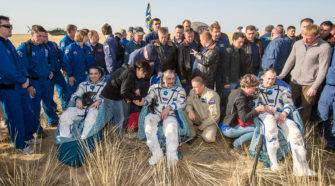
Landing of Expedition 36

Expedition 36 Soyuz landing – The Soyuz TMA-08M spacecraft with Expedition 36 Commander Pavel Vinogradov, Flight Engineer Alexander Misurkin and Flight Engineer Chris Cassidy (sitting far left) landed in a remote area of Kazakhstan on Sept. 11. They returned to Earth after five and a half months serving aboard the International Space Station. This article appeared …
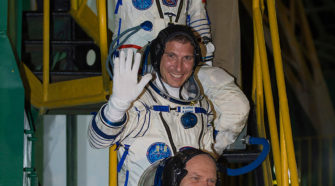
Launch of Expedition 37 to ISS
Expedition 37 launch – The Soyuz TMA-10M rocket launched from the Baikonur Cosmodrome in Kazakhstan on Sept. 26, carrying Soyuz Commander Oleg Kotov, NASA Flight Engineer Michael Hopkins (left, middle) and Russian Flight Engineer Sergei Ryazansky to the ISS. Their Soyuz rocket launched at 2:58 a.m. local time. This article appeared in the 3rd issue of …
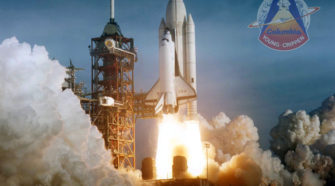
Columbia STS-1 Launch

April 12, 1981: Space Shuttle Columbia launched this day from the LC-39A pad at Kennedy Space Center in Florida. The STS-1 mission lasted just two days, circling the Earth 37 times, before landing at Edwards Air Force Base in California. Columbia carried a crew of two – mission commander John W. Young and pilot Robert …