
Artemis Activities
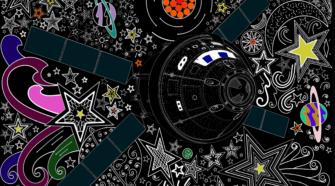
Artemis II Fun Activities

NASA has released a number of activities for children and teenagers ahead of the Artemis II launch to send humans back around the Moon for the first time since 1972. We’ve scoured the space agency’s websites and compiled a number of those activities here, ranging from paper models, drawing guides, children’s books, colorings sheets and …

Stay busy with NASA’s Artemis coloring and activity pages
Put the “art” in Artemis with these 18 coloring and activity pages created by NASA. Through NASA’s Artemis program, the SLS rocket will power a series of increasingly complex missions to the Moon. After you have completed your artwork, share your masterpiece with the hashtag #ColorWithNASA on social media. You also can try to complete …

Artemis I Mission Word Search

NASA is launching the Space Launch System (SLS) rocket and the Orion human-crated spacecraft on their maiden voyage – a long test flight around the Moon and back. We’re celebrating the milestone here at RocketSTEM with a section devoted to Artemis-related articles and activities. In our latest Word Search puzzle, we’ve hidden 33 words related to …
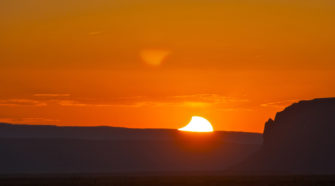
Take a closer look at the Moon

Observing the Moon The object of the month this time is the closest celestial body to us: The Moon. The Moon plays a big part in Astronomy for a number of reasons, the main one being light. Although the Moon does not generate light itself, it acts as a giant reflector for the sun. When …
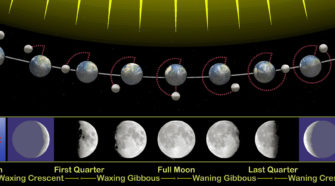
Moon phases: Past, present and future

Take a look tonight at the Moon. What lunar phase do you observe? If you and your students want to learn more about the lunar phases before studying the night sky, we recommend: http://bit.ly/RShiwaay. Observing the Moon night after night and either photographing the phase or drawing it, is a good way to understand the …
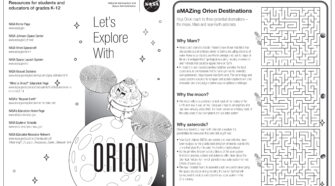
Let’s explore with Orion activity pages
Four pages of activities and information from NASA exploring the upcoming role of Orion and the Space Launch System (SLS) in manned space exploration beyond low Earth orbit (LEO). These pages are available from NASA and geared toward students and educators of grades K-12. This article appeared in the 1st issue of RocketSTEM magazine. …

Why the Moon is bigger closer to the horizon + Moon facts

Why the Moon is bigger closer to the horizon We don’t know. Not the writer, but the human population. That is not to say that there aren’t many theories, but we don’t know truly why. First off, you should probably know that the moon does not get any bigger physically. In fact if you use …