
Milky Way
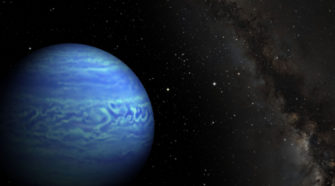
Coldest brown dwarf found nearby

NASA’s Wide-field Infrared Survey Explorer (WISE) and Spitzer Space Telescope have discovered what appears to be the coldest brown dwarf known – a dim, star-like body that surprisingly is as frosty as Earth’s North Pole. Images from the space telescopes also pinpointed the object’s distance to 7.2 light-years away, earning it the title for fourth …
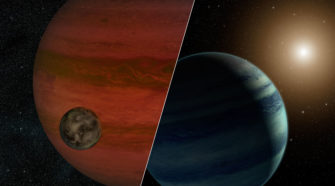
First exomoon possibly found
Titan, Europa, Io and Phobos are just a few members of our solar system’s pantheon of moons. Are there are other moons out there, orbiting planets beyond our sun? NASA-funded researchers have spotted the first signs of an “exomoon,” and though they say it’s impossible to confirm its presence, the finding is a tantalizing first …

Kepler finds nearest twin to Earth yet
Using NASA’s Kepler Space Telescope, astronomers have discovered the first Earth-size planet orbiting a star in the “habitable zone” — the range of distance from a star where liquid water might pool on the surface of an orbiting planet. The discovery of Kepler-186f confirms that planets the size of Earth exist in the habitable zone …
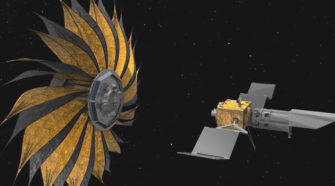
Space sunflower may help telescopes snap pictures of planets
A spacecraft that looks like a giant sunflower might one day be used to acquire images of Earth-like rocky planets around nearby stars. The prototype deployable structure, called a starshade, is being developed by NASA’s Jet Propulsion Laboratory in Pasadena, Calif. The hunt is on for planets that resemble Earth in size, composition and temperature. Rocky …
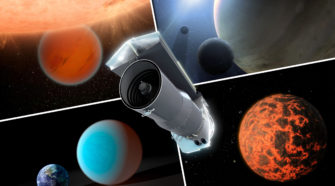
How engineers revamped Spitzer to probe exoplanets
Passing its 10th anniversary, NASA’s Spitzer Space Telescope has evolved into a premier observatory for an endeavor not envisioned in its original design: the study of worlds around other stars, called exoplanets. While the engineers and scientists who built Spitzer did not have this goal in mind, their visionary work made this unexpected capability possible. …
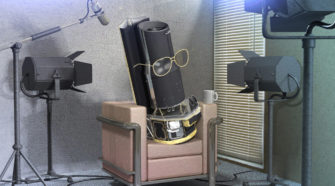
Spitzer: Not a politician; Not a carbonated beverage

Most blog readers are no doubt familiar with the world of space telescopes. But have you ever gone to your friends and asked them what comes to mind when they hear the word “Spitzer?” Chances are, they will ask if you are referring to a certain politician… Or maybe a carbonated beverage. Now is the …
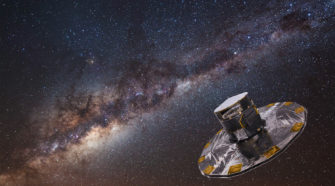
Liftoff for ESA’s billion-star surveyor
ESA’s Gaia is destined to create the most accurate map yet of the Milky Way. By making accurate measurements of the positions and motions of 1% of the total population of roughly 100 billion stars, it will answer questions about the origin and evolution of our home Galaxy. The Gaia mission blasted off the morning …
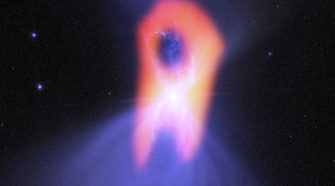
Ghostly specter haunts ‘coldest place in universe’
At a cosmologically crisp one degree Kelvin (minus 458 degrees Fahrenheit), the Boomerang nebula is the coldest known object in the universe — colder, in fact, than the faint afterglow of the Big Bang, the explosive event that created the cosmos. Astronomers using the Atacama Large Millimeter/submillimeter Array (ALMA) telescope in Chile have taken a …
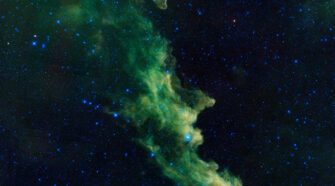
‘Witch head’ brews baby stars
A witch appears to be screaming out into space in this image from NASA’s Wide-Field Infrared Survey Explorer, or WISE. The infrared portrait shows the Witch Head nebula, named after its resemblance to the profile of a wicked witch. Astronomers say the billowy clouds of the nebula, where baby stars are brewing, are being lit up …
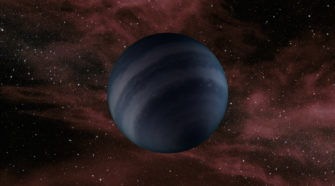
Cold brown dwarfs blur line between stars and planets
In 2011, astronomers on the hunt for the coldest star-like celestial bodies discovered a new class of such objects using NASA’s Wide-Field Infrared Survey Explorer (WISE) space telescope. But until now, no one knew exactly how cool the bodies’ surfaces really are. In fact, some evidence suggested they could be at room temperature. A new …